 Readnauts
Help everyone in your family build a reading habit that lasts.
Readnauts keeps one simple record of every book your family reads, at every age and in every format: library, school, audiobook, bedtime story. Then it turns that into gentle, shared encouragement, so kids and grown-ups keep going together.
14-day free trial, no card. Then $39 a year for the whole family, up to 8 readers.

Your kids read everywhere. The proof lives nowhere.
Library books, school books, graphic novels, audiobooks, bedtime stories. The reading happens, but it's scattered. The momentum fades, and there's no shared sense of how the family is doing.
Readnauts keeps one simple record for everyone, then turns it into encouragement to keep going, so reading becomes a normal part of home, with less nagging and more reading together.
Sound familiar?
Log it. Celebrate it. Keep it.
Reading happens in real books, audiobooks and bedtime stories. Readnauts takes a few seconds afterwards.
1. Log a book in seconds
A grown-up types a rough title. Readnauts finds the book and fills in the cover, author and pages. Add a one-tap reaction if you like. That is the whole habit.
2. Everyone earns points, fairly
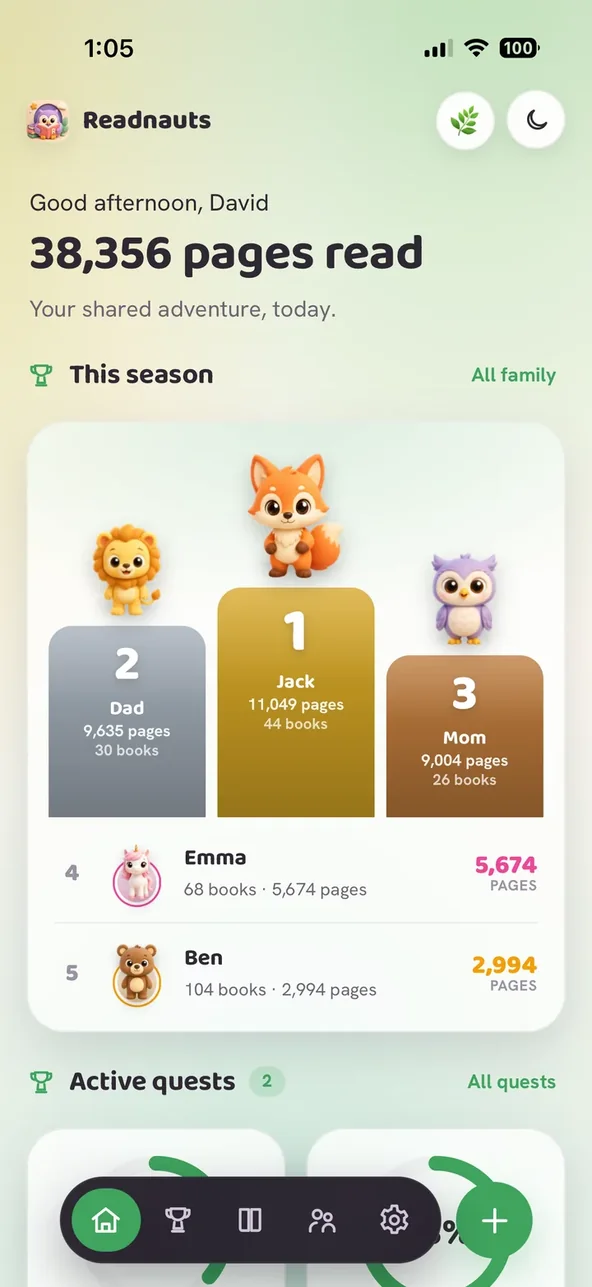
Points are weighted by reading stage, so a picture book, a chapter book and an audiobook all move the family forward. A playful family podium keeps it fun.
3. Keep it for years
Every book lands in that reader's own library. Badges, a reading timeline, a Year in Review and printable certificates build up on their own.

Type a rough title.
We find the exact book.
Half-remembered is fine. Type the title or just part of it, and Readnauts searches so you can pick the book, then fills in the cover, author and page count for you. Read it before? It's flagged as a reread automatically, and still counts.


Everyone makes real progress,
from the 5-year-old to the grown-ups.
Gentle, age-aware scoring means a phonics book, a chapter book and an audiobook each feel like a genuine win. No one is left behind, and no one runs away with it. It makes reading visible enough to celebrate, without turning reading into another test. It matters most around nine to twelve, when reading for fun usually starts to slip.
Ben

Jack
Mom
The weights are set by reading stage and always shown, so the math is never a mystery: early reader 2× · bridge 1.5× · chapter 1.2× · fluent 1× · audiobook 0.85×. The point isn't perfect math; it's that everyone feels proud to keep reading.
A place your family will want to open.
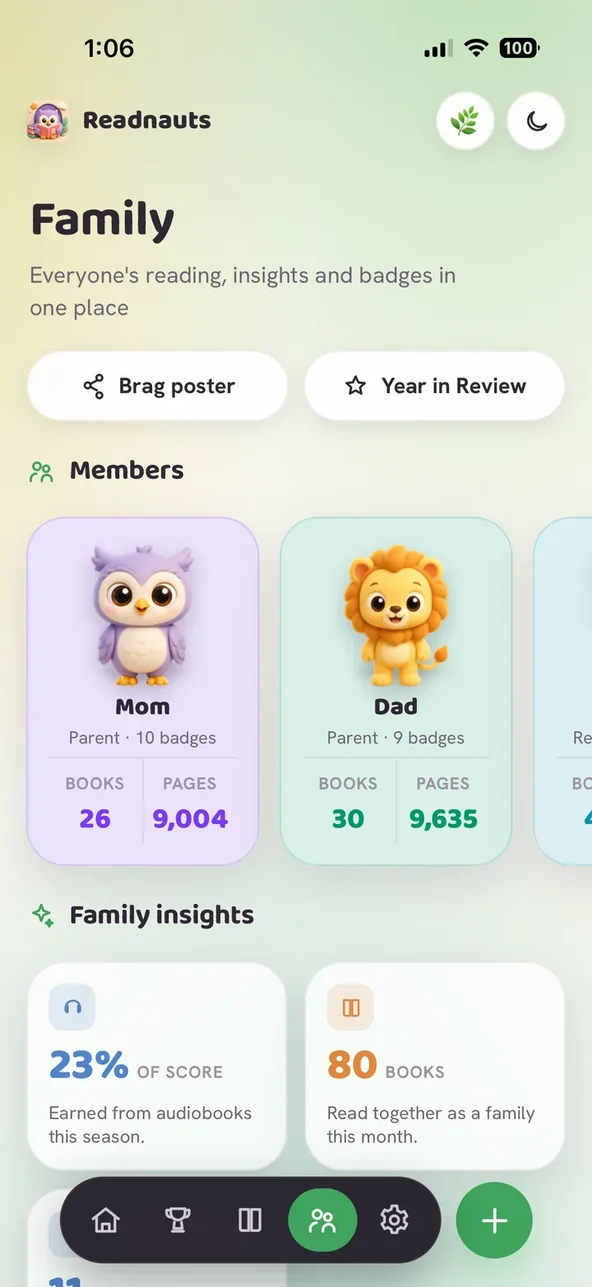
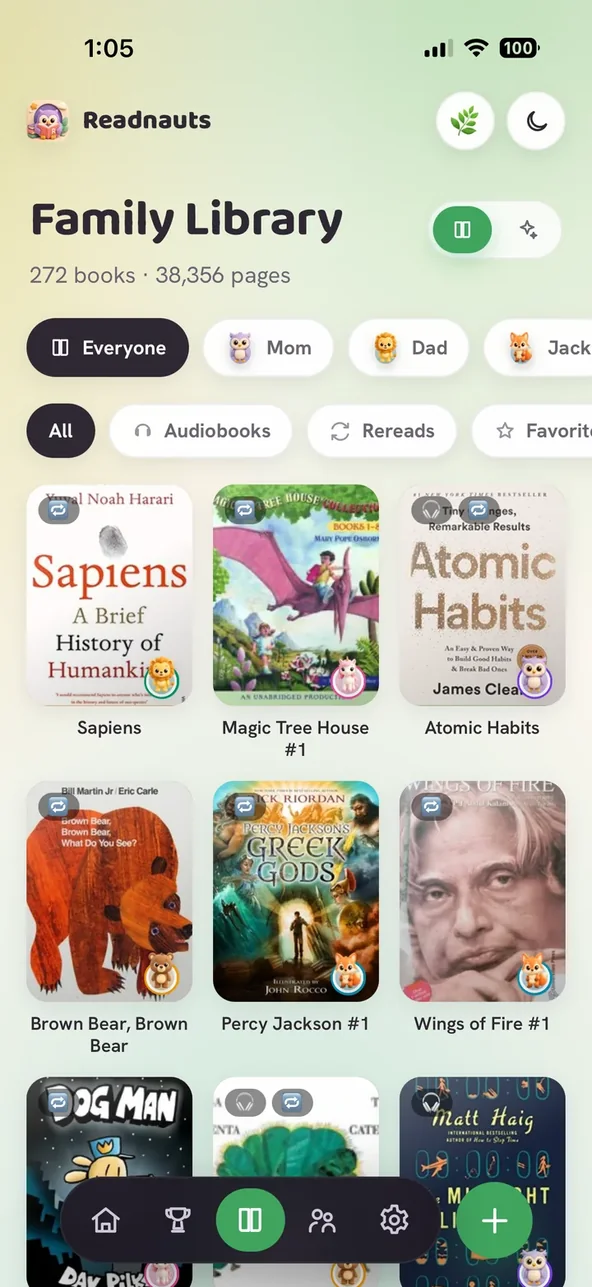
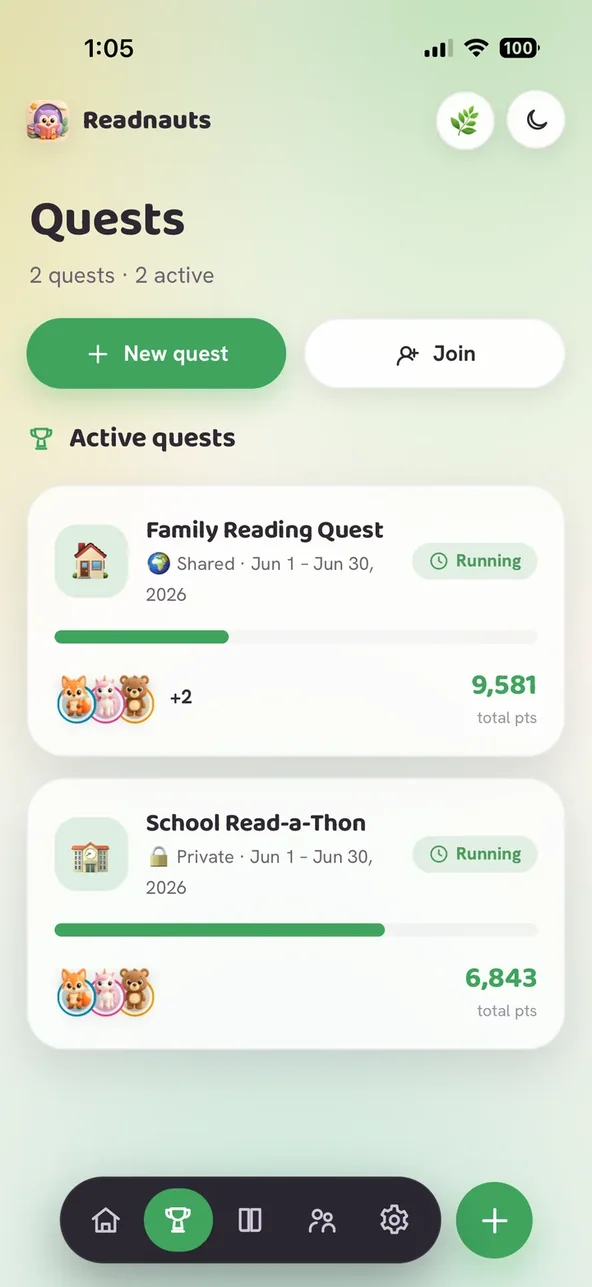
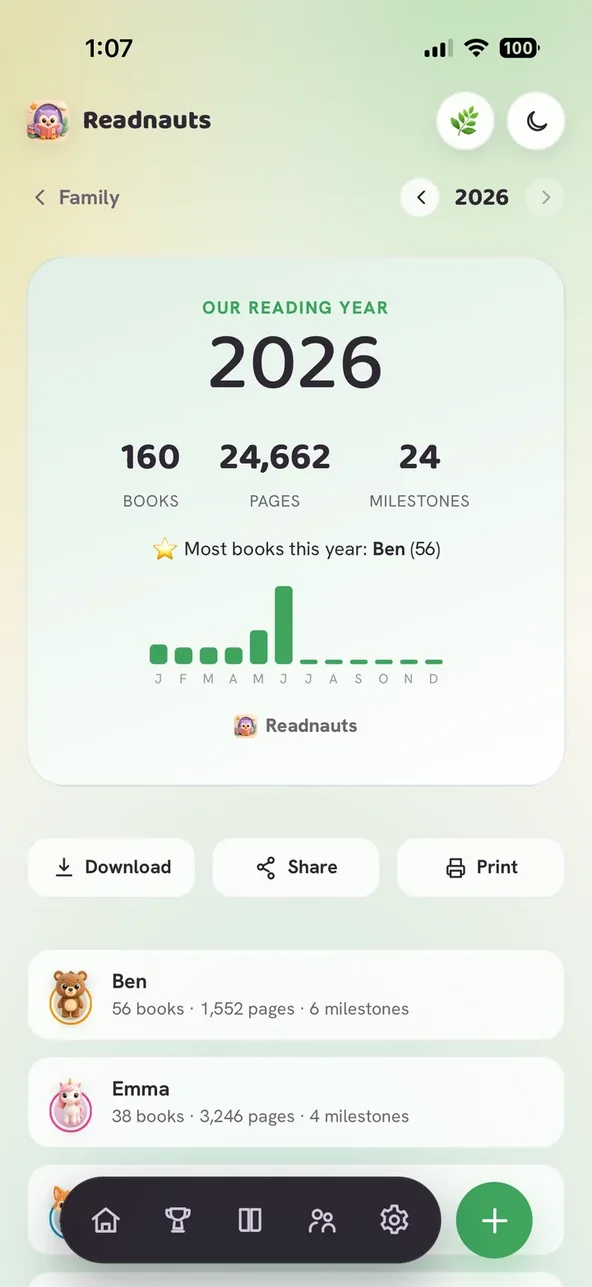
Home, the family view, each reader's library, shared quests, a year in review, and posters to print and share.
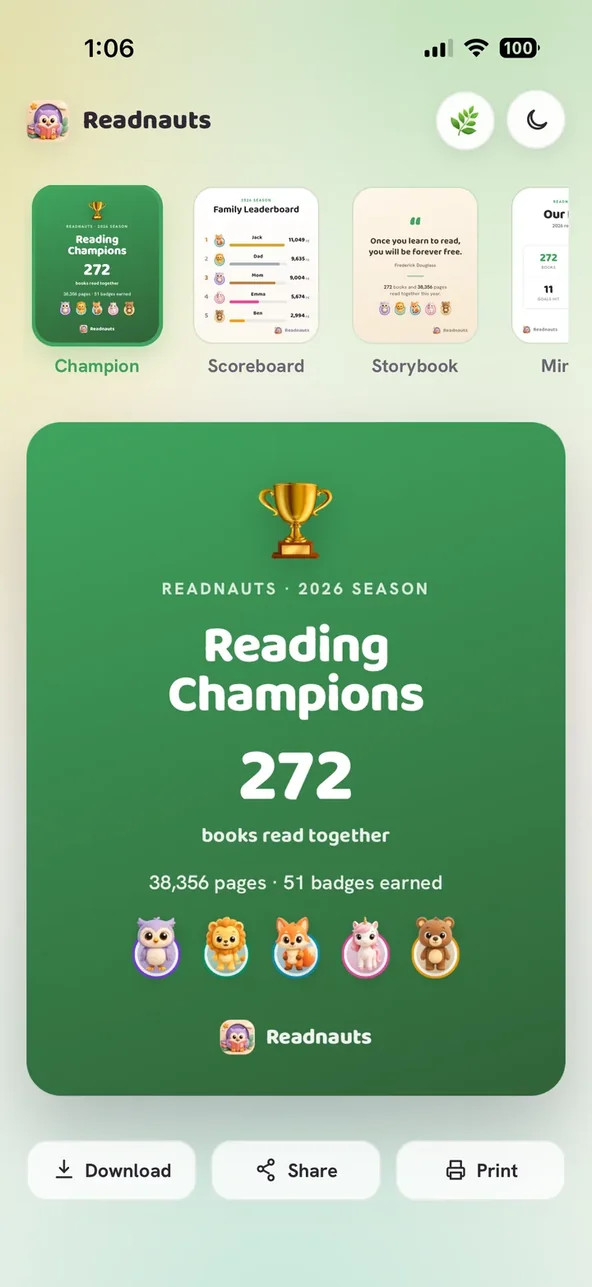
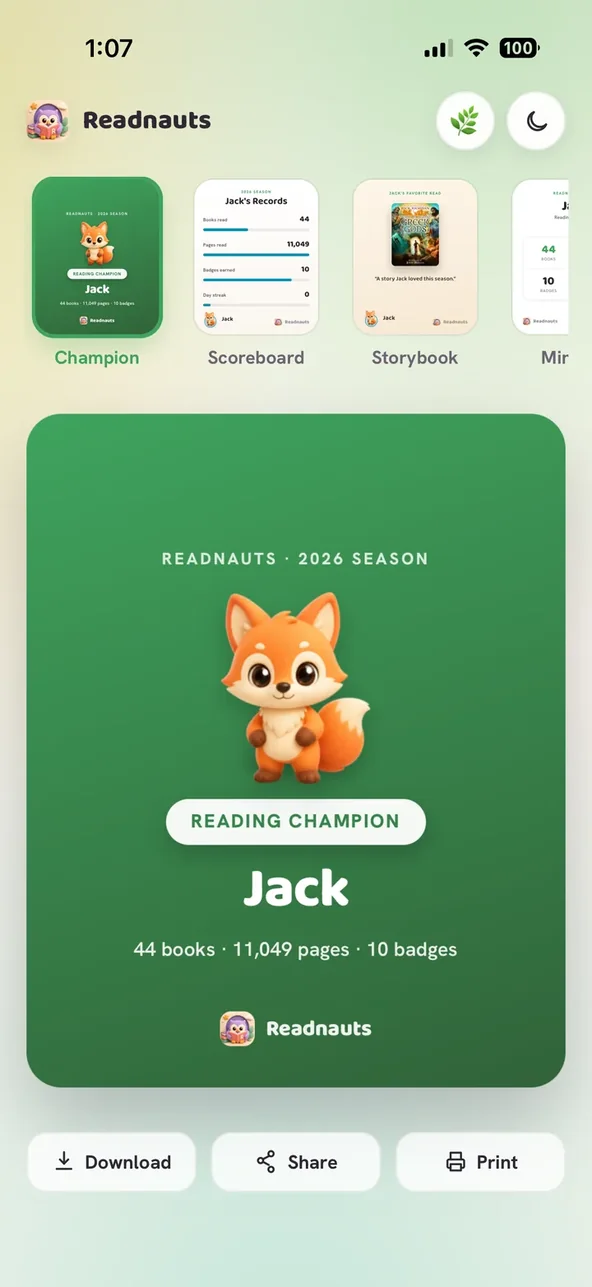
Points are the hook.
The habit is the point.
Kids love earning points and climbing the family podium. We built both on purpose. Here is why, and what the research says, including the part that cuts against us.
What we built
- Every book earns points, weighted by reading stage, so the youngest reader can top the podium.
- Points buy nothing. There are no prizes, coins or unlocks to chase, only a record of real reading.
- Beside the score sit badges, milestones, a reading timeline and a Year in Review, which are about the reader, not the rank.
- Reading happens away from the screen. The app is for the few seconds afterwards.
What the research says
- A review of 128 experiments found that rewards people expect for doing a task tended to reduce their interest in it afterwards, more so for children. The same review found that positive feedback increased interest. Deci, Koestner & Ryan, 1999
- A study that followed 740 children from Grade 3 to Grade 6 found that reading mainly for outside reasons went with weaker reading later, and that the link ran both ways. Becker, McElvany & Kortenbruck, 2010
So we do not claim that research endorses points. It is our judgement that a little play gets a family started, and that reading together is what makes it last. If the score ever becomes the only reason your child reads, talk about the book instead.

Every book belongs to the reader, and stays with them.
Books belong to the reader, not to a program or a school year. The shelf builds up over time, filtered by reader, audiobooks, favorites and rereads, and it's always yours to keep and export.
Years from now, you'll be glad you kept it.
Readnauts quietly turns everyday logging into a keepsake of your family's reading life, theirs to look back on long after any program or school year ends.
Year in Review
A shareable recap of the year: the most-read reader, books and pages, milestones reached and favorite books, month by month.
Reading timeline
Scroll back through every month, with the books each reader finished and the milestones they hit along the way.
Printable certificates
Celebrate a 100th book or a finished read-a-thon with an award you can print and pin to the fridge.

Read together, even across homes.
Set a goal: a summer of reading, a read-aloud month, a library haul. Every book logged moves everyone forward on a shared map. Invite cousins, close friends, even a whole class with a code. Everyone who joins adds to one shared goal, and age-aware points keep it fair for every reader.
Ben Mom Jack Invite with a code
Cousins across the country, a best friend, a whole class. They join your quest from their own Readnauts, and you choose who is in.
Everyone keeps their library
A quest is just a shared view. Each family's books stay theirs; only the reading totals are shared, never a private shelf.
A leaderboard everyone can climb
Each quest has a shared goal and a leaderboard. Because points are weighted by reading stage, a five-year-old's picture books count as much as a grown-up's novel.
See what's working, gently.
Readnauts notices patterns and momentum: who's on a roll, who could use a nudge, and when your family reads most. After each book it also suggests more by the same author.
A running count of what the whole household finished.
Readnauts notices who is reading day after day.
It spots whether weekends or weekdays are your family's rhythm.
A gentle nudge could restart the habit.
At a glance
The tiles on your Family screen
Built around how reading habits really form.
Readnauts leans on three simple, well-understood ideas, and stays out of the way of the reading itself.
Small, steady wins beat big distant goals
Habits stick when progress is frequent and attainable. Short books count, and goals are broken into milestones you actually reach, so momentum keeps building instead of stalling.
Reading grows when families do it together
Children read more when the grown-ups around them read too, model it, and encourage rather than test. Readnauts is built for the whole household, parents and kids on the same shelf, and keeps reflection gentle, never a quiz.
Less time inside a reading app. More time actually reading.
Logging a book takes seconds. Then you close Readnauts and get back to the book. It is built to make someone say “I want to read another one”, not to keep anyone scrolling.
Why it matters now
Reading for fun, and good feelings about reading, show marked declines by age nine that do not rebound.
Scholastic Kids & Family Reading Report → 5 pointsU.S. fourth-grade reading scores in 2024 were 5 points lower than in 2019, a decline that began before the pandemic.
NAEP 2024, U.S. Department of Education → 28 pointsReading scores at age fifteen fell 28 points across OECD countries in ten years, and teens in almost every country report less family support.
OECD PISA 2025 →See what each study found, and what it does not prove →
These are guiding principles behind the design, not clinical claims. Readnauts is a tool to support your family's reading, not a substitute for it.
Already doing a library or school reading program?
Keep doing it. Library summer challenges and school reading programs are wonderful, and many are free. Readnauts is not here to replace them. It is the home record that holds it all, before, during, and long after.
Log your library program here too.
Track the summer reading challenge in Readnauts as you go, so those books count toward your family's own library and goals, not just the program.
Keep the memory after the program ends.
Programs finish and their logs disappear. The reading you did stays in Readnauts, year after year.
Print a log for school or the librarian.
A clean reading report for any date range, with a parent sign-off line, ready for a read-a-thon, a teacher, or homeschool records.
A gentle lock, just for the grown-ups.
Anyone can look around, switch worlds and check the family's progress. A grown-up PIN keeps the things that change family data (adding or deleting books, editing members) safely behind a tap, so nothing gets undone by accident.
You choose exactly what to protect. Changing worlds and exploring always stay open and fun.
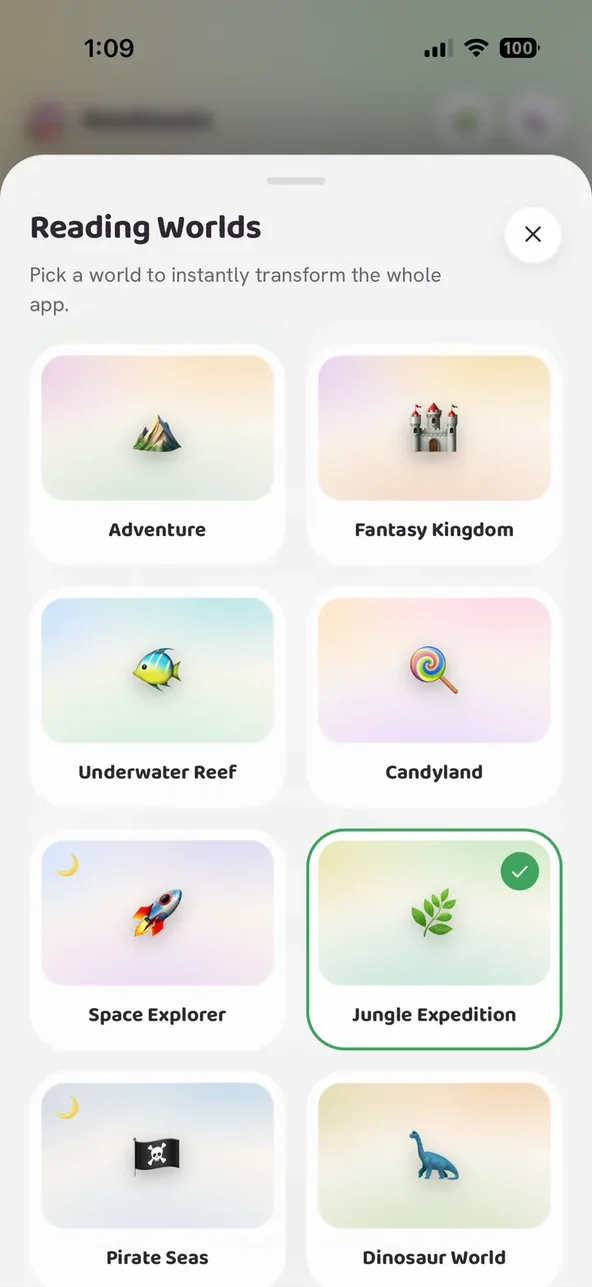
Pick a world to read in.
Tap one to recolor this page, the same way it recolors the app. Each card is painted fresh by code every time you visit.
13 worlds in the app, each with light & dark. More on the way.
Learning doesn't happen in school alone.
A child's learning is shaped first, and most, by the people closest to them. School is one important part of it, not the whole of it. Readnauts starts there, with reading: one reading life that belongs to your family and follows every reader as they grow.
Start your family's reading library.
Log the reading you already do, celebrate every reader fairly, and keep the habit going, together. Start with a 14-day free trial, no card. Then $39 a year for the whole family, and the first 100 families lock in $19 a year for life.